Blog - Elite Rental Exotics

Stop Overpaying: Cheap Exotic Car Rental Miami – Best Value Guide

Cheap exotic car rental Miami services have become the ultimate secret for those who understand that Miami runs on a simple, brutal currency: perception. Whether you are pulling up to Komodo in Brickell or cruising down Ocean Drive, the car you drive announces who you are before you even step out.

But here is the secret that the big agencies like Dream Exotic or Pugachev don’t want you to know: You do not need to spend $1,500 a day to look like you own the city. Most tourists burn their budget on a Ferrari F8 or a Lamborghini Urus. The locals? They play the game of «Smart Luxury.»

We have analyzed the current rental market, cross-referencing daily rates, deposit requirements, and the all-important «Head-Turning Factor,» to bring you the definitive list of best value luxury cars in Miami. These vehicles offer 99% of the visual impact for 30% of the price.

1. Chevrolet Corvette C8: The Undisputed King of Value

Cheap Exotic Car Rental Miami

If you only read one recommendation, make it this one. The Corvette C8 has completely disrupted the exotic car market. It is the «Supercar Killer» .

  • The Flex: With its mid-engine design, aggressive air intakes, and sharp angles, the C8 is frequently mistaken for a Ferrari or a McLaren by the general public .

  • The Math: While a Ferrari or Lamborghini can cost you over $1,200 per day, the Corvette C8 offers the aesthetic of a $300,000 car for a fraction of the price . You can typically find these for $349 – $495 per day.

  • The Experience: You get a removable Targa top perfect for the Florida sun and a driving experience that rivals cars triple its price .

  • Verdict: The smartest choice in the market .

If you want to secure the best rates for these specific models, we recommend checking live availability now.


Check Current Rates at Elite Rental Exotics

2. BMW i8 Roadster: The «Spaceship» on a Budget

Cheap Exotic Car Rental Miami

If your goal is to end up on Instagram, the BMW i8 is unbeatable. Its butterfly doors (which open upwards) create a scene every time you park.

  • The Flex: It looks like a concept car from the future. The futuristic design commands just as much attention as a Lamborghini.

  • The Math: While it looks like a million bucks, rental prices have stabilized beautifully. You can often secure an i8 Roadster for around $400 – $499 per day.

  • Insider Tip: The hybrid engine is silent in the city but fast on the highway. It’s perfect for South Beach where «cruising» matters more than racing.

3. Porsche 718 Boxster: The Badge of Sophistication

Best value luxury cars Miami

While the Lamborghini screams for attention, a Porsche whispers competence. It is the choice of the purist .

  • The Flex: You are driving a German convertible with the iconic crest on the hood. It signals that you have taste, not just money.

  • The Math: This is where the savings are massive. While the bigger Porsche 911 costs significantly more, the 718 Boxster can often be found for a shocking $150 – $250 per day.

  • Verdict: The best «Dollar-to-Status» ratio for a convertible in Miami.

4. Range Rover Sport: The «Boss» SUV

Not everyone wants a low-slung sports car. If you are traveling with a group or just want to physically look down on traffic, you need a luxury SUV.

  • The Flex: The Range Rover is the uniform of Miami’s elite. It commands respect at every valet stand.

  • The Math: The Mercedes G-Wagon (G63) is the most popular SUV, but it comes with a high price tag . The Range Rover Sport offers a similar level of «road dominance» and luxury interior for just $300 – $395 per day.

  • Strategy: Use the money you save to upgrade your hotel room or reserve a VIP table.

5. Maserati Ghibli: The «Fake It ‘Til You Make It» Masterpiece

Luxury car rental under $300 Miami

This is a controversial pick for car enthusiasts, but a genius pick for renters.

  • The Flex: To the average person, a Maserati is as exotic as a Ferrari. It sounds Italian, it looks aggressive, and it has the trident logo.

  • The Math: Because Maseratis depreciate quickly, they are incredibly cheap to rent. You can find deals ranging from $100 to $200 per day.

  • Verdict: If you need a luxury sedan for a business meeting or a date night in Brickell, this is the most affordable way to arrive in an «exotic» brand.

6. Ford Mustang Shelby GT500: The American Beast

Cheap exotic car rental Miami

Do not confuse this with the standard rental Mustang you get at the airport. The Shelby GT500 is a completely different animal.

  • The Flex: It is loud, menacing, and features the iconic Cobra emblem. It earns immediate respect from car lovers and adrenaline junkies.

  • The Math: It competes with supercars in terms of horsepower (700+ hp) but rents for the price of a mid-tier sedan, approximately $399 per day.

  • Why choose it: It is arguably the most powerful car you can rent for under $400.

7. Jaguar F-Type Convertible: The British Villain

Cheap exotic car rental Miami

If you want something sexier than a Porsche and rarer than a Corvette, the Jaguar F-Type is the hidden gem of the rental market.

  • The Flex: It is widely considered one of the most beautiful cars designed in the last decade. Plus, the exhaust note is legendary.

  • The Math: Rental prices are surprisingly low, often sitting in the $150 – $300 range.

  • Verdict: A stylish, romantic choice for a couple’s getaway to Key West.

How to Secure These Prices

To truly win the game of cheap exotic car rental Miami and position yourself above the average tourist, you must navigate the fine print :

  1. Avoid the Deposit Trap: Some «cheap» agencies will lure you in with a low daily rate but demand a massive security deposit. Look for agencies that are transparent about their Security Deposit policy .

  2. Book in Advance: Dynamic pricing in Florida means rates spike drastically near the weekend . Booking 2 weeks out is the sweet spot.

  3. Check the Miles: Ensure your «Best Value» deal includes unlimited miles or a high daily cap. Many cheap agencies charge extra per mile, which kills the value .

Drive Smarter, Not Harder

Miami is a city of illusions, but your bank account is real. You do not need to be a millionaire to live the dream . By choosing «Smart Luxury» vehicles like the Corvette C8 or the Range Rover Sport, you get the full Miami experience—the valet respect, the photos, the thrill—without the financial hangover.

Choose intelligence, choose value, and dominate the streets of Florida .

Ready to Drive Like a Millionaire for Less?

Don’t let the high prices of big agencies stop you. Experience the thrill of a supercar in South Beach today at a price that makes sense.


View Available Cars & Book Now

Road Trip Drag Challenges: Why the NHRA U.S. Nationals Remains King

In the world of high-stakes, high-horsepower retas, few places carry the historical weight and sheer prestige of Indianapolis during Labor Day weekend. This is the home of «The Big Go,» the NHRA U.S. Nationals. While many casual events and unsanctioned street races grab headlines, the U.S. Nationals is the gold standard—a proving ground that draws not only the professional Top Fuel teams but also a massive contingent of exotic and street-legal performance cars seeking glory.

For the serious exotic car owner who tunes and races, participating in or even attending this event is a pilgrimage. It’s where history is made and where the culture of competitive speed is most deeply rooted.


The Unrivaled Prestige of «The Big Go»


First held in 1955, the NHRA U.S. Nationals quickly became the National Hot Rod Association’s most celebrated event. It’s often compared to the Indy 500 or the Daytona 500 within its sport, marking a place where winning grants instant, lifelong legendary status.

What makes it so significant for the exotic car community is the depth and breadth of the competition. Beyond the massive professional classes, the event hosts countless sportsman and bracket classes. This is where owners of street-driven supercars—from highly tuned twin-turbo Lamborghinis to modified Corvette Z06s and Porsche 911 Turbos—come to test their engineering prowess and driving skill against the best in the country. The sheer scale of the event, coupled with its historical importance, attracts the finest builders and drivers, making every class intensely competitive.


The Culture Surrounding the NHRA U.S. Nationals


The Drag racing culture at Indianapolis Raceway Park (IRP) during the Nationals is unlike any other. It is a five-day festival of speed, sound, and camaraderie.

  • The Pits: The spectacle is not limited to the track. Walking the sprawling pit area offers an unparalleled look at automotive excellence. You’ll find meticulously prepared Top Fuel dragsters alongside the latest, million-dollar hypercars, all sharing the same paddock space. For enthusiasts, it’s a giant, open-air garage and an educational experience.
  • The Stakes: While prize money is substantial in professional classes, for the exotic car owner competing in sportsman brackets, the real prize is the prestige of taking home the iconic NHRA «Wally» trophy. Winning a Wally at the NHRA U.S. Nationals is the ultimate validation of a car’s build and a driver’s skill.
  • The Lifestyle: The event is a social magnet, drawing exotic car clubs, collectors, and builders from across North America. It fosters a lifestyle defined by passion, meticulous maintenance, and the constant quest for a faster elapsed time.


Why Your Exotic Car Needs This Experience


If your blog promotes the thrill of exotic car retas, covering or participating in Major drag race events like this one is essential. It connects the localized retas scene with the global, historical context of motorsports.

The NHRA U.S. Nationals provides a unique backdrop to test the principles discussed in our other articles:

  • Car Analysis: Which hypercar platform proves most durable under the stress of five days of competitive runs?
  • Driving Tactics: Which drivers maintain the consistent 60-foot times needed to advance through elimination rounds?
  • Tuning Extremo: Which turbo configurations survive the high heat and extreme demand of multiple back-to-back runs?

In conclusion, «The Big Go» is more than a race; it is the annual benchmark for performance. For any exotic car enthusiast who believes their machine is the fastest, the NHRA U.S. Nationals is where they must prove it.

The Power Multiplier: Choosing the Best Exotic Car Turbo Upgrade

For the dedicated drag racer, the factory horsepower of a supercar—be it 700, 800, or even 900 HP—is merely a floor, not a ceiling. To enter the exclusive realm of 1,000+ horsepower that dominates high-stakes retas, a serious commitment to forced induction is required. For most modern exotics, this journey begins and ends with an Exotic Car Turbo Upgrade.

Turbochargers are mechanically superior for generating the highest possible horsepower because they run on otherwise wasted exhaust gas energy, making them far more efficient at producing massive boost than engine-driven superchargers. However, chasing four-digit horsepower figures requires a meticulous plan that goes far beyond simply bolting on a bigger turbine.


The Great Debate: Turbo vs. Supercharger in Retas


Before diving into how to upgrade a turbo, many builders consider the alternative: the supercharger.

Feature Turbocharger (Exotic Car Turbo Upgrade) Supercharger (Engine-Driven)
Power Potential Highest potential; can easily reach 1500+ HP. High, but usually capped lower than turbos (1000-1200 HP).
Power Delivery Lag: Power hits suddenly after «spooling.» Ideal for high-speed top-end performance. Linear: Instant power from idle; great for launch consistency.
Efficiency More efficient as it uses exhaust gases (non-parasitic). Less efficient as it draws power directly from the crankshaft (parasitic loss).
Heat Management Generates more heat; requires larger intercoolers. Generates less overall heat.

For serious drag racing where maximum trap speed is the goal, the turbocharger’s ability to create massive boost pressures and its inherent efficiency make the Exotic Car Turbo Upgrade the undeniable choice for chasing world-class times.


Selecting the Right Exotic Car Turbo Upgrade


When upgrading a twin-turbo exotic (like a Lamborghini Huracán or a high-end Porsche 911 Turbo), you typically face two paths:


1. Hybrid Turbo Upgrades


This option keeps the factory turbo housing but replaces the internal components (the turbine and compressor wheels) with larger, lighter billet parts. This is a great choice for builders aiming for a reliable 850–1,000 HP, offering a significant boost in performance while retaining near-OEM spool time (minimal turbo lag).


2. Full Custom Turbo Kits


To surpass 1,200 HP and aim for the 1,500 HP range (or higher), a full replacement kit with much larger turbochargers is necessary. This requires custom manifolds, large-diameter piping, and often moves the turbos to a different location (like the rear of the vehicle, known as a «rear-mount» setup) to save space and reduce heat under the hood. This path delivers immense power but requires significant engine internal reinforcement.


The Non-Negotiable: Supporting Modifications for High-HP Reliability


A larger turbo is useless—and potentially engine-destroying—without the correct supporting modifications. Ignoring these components is the fastest way to turn an expensive upgrade into an explosion.

  1. Fuel System: Increased boost requires dramatically more fuel. You must upgrade to high-flow fuel injectors, larger fuel pumps (often multiple), and reinforced fuel lines. Insufficient fuel can lead to a lean condition and catastrophic engine failure.
  2. Engine Internals: For power over 1,000 HP, the stock pistons and connecting rods cannot withstand the stress. Upgrading to forged pistons and rods is mandatory for High-HP reliability.
  3. ECU Tuning: This is the most critical step. The engine’s Electronic Control Unit (ECU) must be professionally remapped to optimize the air-fuel ratio (AFR), adjust the ignition timing, and manage the new boost curve. A proper tune ensures the engine runs safely and efficiently with the new power.
  4. Cooling: Increased power generates extreme heat. Upgrading the intercooler (often to a front-mounted liquid-to-air unit) is necessary to keep the air entering the engine cool and dense, which is essential for making power safely.


The Thrill of the Boost


The Exotic Car Turbo Upgrade is the ultimate expression of performance tuning. While it demands considerable investment and expertise, the reward is an exotic car capable of humiliating most other machines on the drag strip. By prioritizing not just raw boost, but the necessary supporting mods and a professional tune, you can unlock the full potential of four-digit power with the reliability needed to win retas consistently.

Hypercar Technology 2025: The Rise of Active Aero Systems

The era where extreme speed relied solely on engine power is over. Today’s hypercars are defined by their mastery of the air around them. As manufacturers push vehicles past the 250 mph (400 km/h) threshold, the difference between stability and disaster is managed by sophisticated computers adjusting movable wings, spoilers, and flaps in real-time. This technological evolution is the Active Aero Systems revolution, and it is fundamentally changing the physics of high-performance driving.


The Duel Against Drag and Downforce


Every hypercar designer faces a perpetual trade-off: minimizing aerodynamic drag to achieve maximum top speed versus maximizing downforce to ensure stability and cornering grip. Active Aero Systems provide the elegant solution to this paradox.

These systems are complex networks of sensors, actuators, and motors managed by the vehicle’s central control unit. Their primary function is to continuously optimize the car’s aerodynamic profile based on the driver’s inputs and vehicle speed.

For example, when a car is accelerating on a long straight, the system puts the car into a low-drag mode (or «DRS» mode, borrowing a concept from Formula 1). The rear wing flattens, and front flaps may close, allowing the vehicle to punch through the air with minimal resistance to maximize velocity.

The moment the driver hits the brakes or steers into a high-speed corner, the system instantly switches to a high-downforce mode. The rear wing pivots sharply to act as an air brake and maximize downforce, pushing the tires harder into the pavement to maintain traction and shorten braking distances.


The Role of Active Aero Systems in Exotic Car Retas


While drag races are typically judged on a straight line, the efficiency provided by Active Aero Systems contributes directly to performance in two key areas:


1. Max Speed and Stability in the Final Stretch


The ability to dynamically flatten the wing reduces drag significantly in the final portion of the quarter-mile and, especially, in half-mile or full-mile retas. This allows the car to reach a higher terminal velocity (trap speed) at the finish line. At over 180 mph, a well-managed aerodynamic profile is more beneficial than an extra 50 horsepower.


2. Post-Race Braking and Safety


Once the finish line is crossed, the car still carries immense kinetic energy. The instantaneous deployment of the rear wing as an air brake is a vital safety feature. This dramatic increase in drag helps scrub off huge amounts of speed very quickly, an essential capability for exotic cars racing on shorter strips or closed roads.


Innovators in Active Aero Systems for 2025


Several manufacturers are pushing the envelope with innovative Active Aero Systems.

  • Aston Martin Valhalla: Expected to feature complex underbody aerodynamics and multi-stage active wings that produce massive downforce while maintaining an accessible road profile.
  • McLaren: Continues to refine its system, focusing on seamless integration between aerodynamics and its hydraulic suspension to create a perfectly balanced platform for high-speed use.
  • Bugatti: Uses large, single-piece air brakes that pivot to manage drag, a testament to maximizing downforce at astronomical speeds.

As Active Aero Systems become standard in the hypercar segment, they represent a clear trend: the next generation of speed will be won not only by those who generate the most power but by those who can control the forces of nature most effectively.

The Art of the Perfect Launch: Mastering Drag Racing Launch Control

In a quarter-mile drag race, a flawless start is not just a preference—it’s a prerequisite for victory. Modern exotic cars possess over 700 horsepower, a monumental figure that is useless if the driver can’t deliver it efficiently to the pavement. The solution lies in the sophisticated electronic brain of the car: Drag Racing Launch Control.

For those who compete in high-stakes retas, mastering this technology is the ultimate driving tactic. It transforms a potential burnout disaster into a clean, explosive surge of acceleration. But simply pushing the button isn’t enough; true mastery requires understanding the science behind the system and executing a precise routine.


The Most Important 60 Feet of the Race


Before delving into the control system itself, it is crucial to understand the importance of the 60-foot time. This is the elapsed time it takes for your vehicle to travel the first 60 feet (approximately 18 meters) of the track.

Why is it vital? Any time lost in the first 60 feet is almost impossible to recover, regardless of the horsepower you have down the straight. A difference of just one-tenth of a second (0.1s) in the 60-foot time can translate to two to three tenths of a second (0.2s–0.3s) lost on the final elapsed time (ET) slip. The Drag Racing Launch Control system exists solely to minimize that 60-foot number, ensuring maximum tire grip without excessive wheel spin.


How to Execute a Flawless Drag Racing Launch Control Start

Drag Racing Launch Control

While the exact sequence varies slightly between manufacturers (Ferrari, Lamborghini, McLaren, Porsche, etc.), the core principles for activating and optimizing the system remain the same:


Step 1: Car Preparation and Warm-up


The system operates based on specific thermal and pressure parameters. You must ensure all fluids (engine oil, transmission fluid) have reached their optimal operating temperature. Furthermore, the tires must be heated and cleaned. For street-legal exotics with performance radial tires, a controlled, brief burnout (or simply rolling through the water box and spinning the tires lightly to clean them) is often necessary to maximize the exotic car grip for the launch.


Step 2: Activating the System


Locate and engage the launch control mode. This is usually done through a dedicated button (like in a Porsche 911), a paddle sequence (on some Ferraris), or selecting a specific drive mode (like ‘Race’ or ‘Track’). A key signal, usually an icon on the dash, will confirm the system is armed.


Step 3: The Pre-Launch Sequence


This is the most critical driver input.

  1. Staging: Roll slowly into the staging beams to light the pre-stage light, and then creep forward with extreme precision to light the stage light. Aim for a ‘shallow stage’ to maximize rollout before the timing starts.
  2. Brake and Throttle: With your left foot pressing the brake pedal firmly, immediately press the accelerator pedal fully to the floor with your right foot. The Drag Racing Launch Control system will automatically hold the engine at a specific, predetermined RPM (often between 3,500 and 5,000 RPM, depending on the car’s setup). This maximizes the available torque at the moment of release.
  3. Wait for the Last Light: Hold this position until the final yellow light turns on (or green, depending on the light tree).


Step 4: The Release


The instant you see the final light change, immediately and completely release the brake pedal.

Do not lift the throttle; keep it pinned to the floor. The electronics take over, modulating the clutch, transmission, and power delivery in milliseconds to prevent wheel spin while applying maximum force. The result is the terrifying, yet perfectly controlled, explosion of speed that defines the winner.


Achieving a Consistent 60-Foot Time


The difference between a good driver and a champion is repeatability. Launch control helps, but human consistency matters:

  • Tire Pressure: Experimentation is key. Finding the optimal hot tire pressure for your setup and track conditions can shave precious hundredths of a second.
  • Warm-up: Always ensure the car is fully warm. Cold differentials or transmissions will result in a harsher, less efficient launch.
  • Driver Input: Practice releasing the brake cleanly and immediately. Hesitation or a jerky movement can momentarily confuse the electronics, leading to a poorer 60-foot time.

Mastering the use of Drag Racing Launch Control is the single best way to ensure that your exotic car’s massive horsepower translates into victories, turning you from a mere driver into a true track tactician.

The Ultimate V8 Showdown: Why the 720S Drag Race Performance Still Edges the F8 Tributo

The rivalry between Woking (McLaren) and Maranello (Ferrari) has always been defined by milliseconds, a relentless pursuit of the fastest time, and the most efficient application of power. In the modern era of twin-turbo V8 supercars, this battle is epitomized by the McLaren 720S and the Ferrari F8 Tributo. Both machines produce identical, mind-bending power figures—around 710 to 720 horsepower—yet, when the lights drop, data shows a razor-thin advantage for the British contender. The question for any serious competitor in exotic car retas is: Why does the 720S drag race performance consistently set the benchmark?


The Core Numbers: A Battle of Equivalence


On paper, the two cars are almost interchangeable.

Metric McLaren 720S (Stock) Ferrari F8 Tributo (Stock)
Engine 4.0L Twin-Turbo V8 3.9L Twin-Turbo V8
Horsepower 710 – 720 hp 710 – 720 hp
Torque 568 lb-ft 568 lb-ft
0-60 mph (Official) 2.8 seconds 2.9 seconds
Weight Approximately 3,130 lbs (Dry) Approximately 3,160 lbs (Dry)

The nominal differences in displacement and official 0-60 times are negligible. However, real-world data, especially from DragTimes and similar channels using professionally prepped tracks, reveals that the 720S often runs quarter-mile times in the low 10-second range (sometimes even dipping into the 9s with optimal conditions and tires), establishing its reputation for phenomenal speed and consistency. The key to this dominance lies in engineering factors beyond simple power output.

McLaren 720S

The McLaren Advantage: Power-to-Weight and Launch Control


While the Ferrari F8 Tributo quarter mile time is blisteringly fast—typically matching the 720S in a perfect run—the McLaren has a higher ceiling for consistent, repeatable speed, even under less-than-ideal conditions. This comes down to two critical engineering decisions by McLaren:


1. The Carbon Fibre Monocage II Structure


The 720S is built around the Carbon Fibre Monocage II, a structure that provides immense rigidity while keeping the car’s weight astonishingly low. Even with fluids and a driver, the 720S maintains a superior power-to-weight ratio compared to the F8. In a race where every pound counts towards inertia and acceleration, this lightweight architecture allows the 720S’s horsepower to translate into forward motion more efficiently. This foundational lightness is an advantage that cannot be tuned away.


2. The Sophistication of Launch Dynamics


The true magic behind the consistently dominant 720S drag race performance is its launch control and suspension integration. The Ferrari F8’s launch control is exceptional, refined from years of experience. But the McLaren’s system works in conjunction with its innovative Proactive Chassis Control II (PCC II).

Proactive Chassis Control II is a hydraulic suspension system that replaces conventional anti-roll bars. When the launch control is activated, the PCC II uses a complex network of sensors and hydraulic dampers to precisely manage weight transfer. Instead of stiffening the entire car, the system intelligently controls pitch and dive. This ensures that:

  • Optimal Grip is Maintained: By reducing the car’s tendency to squat excessively on the rear axle, the system keeps the tire contact patch flat and consistent, maximizing traction from the very first inch.
  • Power Delivery is Smooth: The electronics manage the torque curve coming out of the engine to precisely match the available grip, preventing the aggressive tire spin that can plague high-horsepower, rear-wheel-drive launches.

This synergy means the 720S is less reliant on the absolute stickiness of the drag strip and is more forgiving of minor imperfections in the launch sequence, leading to its trademark repeatable low quarter-mile times.


The F8 Counterpunch: Engine Response and Sound

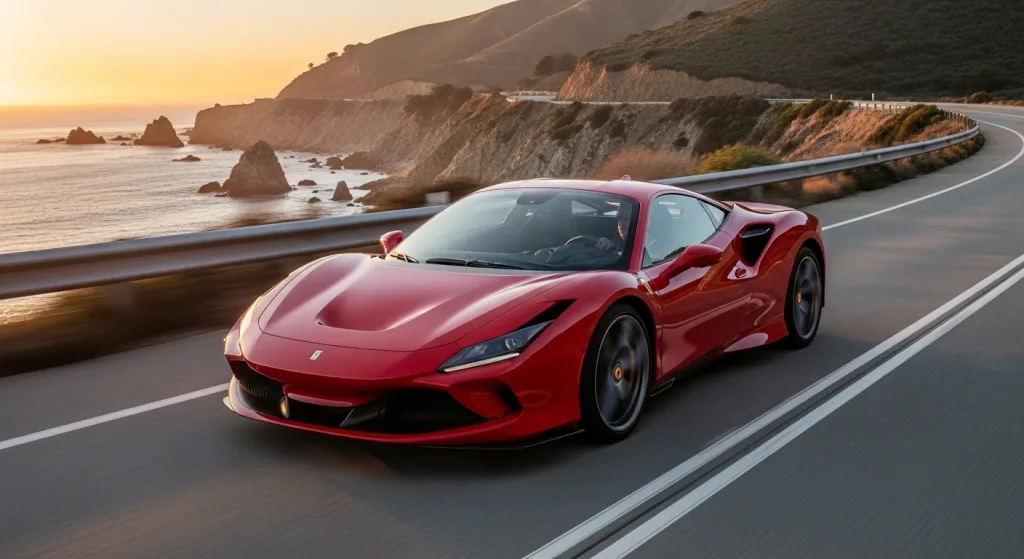
Ferrari F8 Tributo

While the 720S drag race times may be marginally quicker, the Ferrari F8 Tributo has significant advantages in other areas of performance and driver experience. The F8 engine, adopted from the track-focused 488 Pista, boasts technological advancements like titanium con-rods and an innovative intake system that delivers a sharper, more immediate throttle response, virtually eliminating turbo lag. For many drivers, the auditory experience and the raw, analogue feeling of the F8’s power delivery—coupled with its superior aerodynamics like the S-Duct—make it the more emotionally engaging choice, especially when transitioning from the straight strip to a road course.


A Question of Consistency vs. Soul


For Exotic Car Retas where the absolute quickest time is the only metric that matters, the McLaren 720S, thanks to its superior weight advantage and the hyper-efficient management of its Drag Racing Launch Control via the PCC II system, remains the default choice. Its engineering is laser-focused on efficiency and speed.

However, the Ferrari F8 Tributo is a worthy and often faster challenger, especially when conditions are perfect or the driver is a master of its launch sequence. The choice between them ultimately comes down to whether you prioritize the cold, hard, repeatable efficiency of the 720S drag race mastery or the visceral, exhilarating scintilla of Italian V8 performance.